Who was the first electric blues guitarist recorded?
BLUESMUSE26.
Just like Eddie.
There are two answers, really, because the first recording of an electric blues guitar was for demonstration purposes only. It was during the days when Rickenbacker was testing out the first electric guitar which guitar geeks (sorry, aficionados) will know was nicknamed the frying pan.
In 1932, a 28-year old white band leader and Hawaiian guitarist called Gage Brewer, from Wichita, Kansas, recorded Eddie Green’s 1918 blues composition, ‘A Good Man is Hard to Find’, as a demonstrator
record for the new electric guitar company.
record for the new electric guitar company.
While not a commercial recording, this is thought to be the first time anyone had played an electric guitar publicly. Brewer later took the new electric guitar on the road with his band; and broadcast the Rickenbacker’s exciting new sound over local radio.

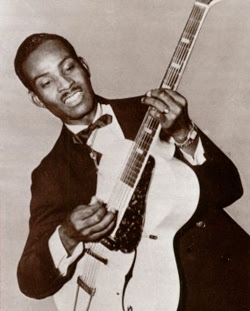
Probably the first blues-oriented electric guitar ever recorded commercially was by the virtuoso trombonist and guitarist, Eddie Durham. Of African American, Irish, Mohawk and Cherokee Indian descent, Eddie Durham was from San Marcos, a place so deep in the heart of Texas, he spoke only Spanish as a youngster. In September 1935, when Eddie was 29, he recorded some bluesy electric guitar licks with amplification he had rigged up himself, on the swing era tune, ‘Hittin’ The Bottle’, for the black bandleader, Jimmie Lunceford.
Eddie Durham would later teach Charlie Christian how to play the electric guitar and is also credited with recording the world’s first electric guitar jazz solo on Lester Young’s Kansas City Five sessions in 1938. Eddie Durham co-wrote Count Basie’s ‘Topsy’, arranged Glenn Millar’s iconic Second World War anthem, ‘In The Mood’, and worked with everyone from Billie Holiday and Cab Calloway to Artie Shaw and Earl Hines.
Listen to Eddie Durham in 1935 below. His electric guitar comes in after 48 seconds.
Hi, "A Good Man Is Hard To Find" is not a "blues" song as those are usually understood. Eddie Durham himself said that "Hittin' The Bottle" was acoustic (with resonator); he first recorded on electric with Basie in '37 (before those '38 recordings). Durham wasn't necessarily the first jazz musician to record on electric, e.g. Zeke Campbell played in an essentially jazzy style on Texas recordings earlier. Best wishes, Joseph Scott
Many thanks for your comments, Joseph, and your interest in the Eddie Durham post. Looking back at it, the post said Eddie recorded Hitting The Bottle in September 1935 with a guitar he'd put through a home-made amplifier. And to my ears, his licks sound more like blues than anything else. I don't think Zeke Campbell recorded until 1936 and wasn't he country rather than blues?
I've always considered A Good Man Is Hard To Find as a blues song as recorded as such true blues divas as Bessie Smith? The white singer Marion Harris, incidently, recorded it in 1919 before the blues style as we know it today was formulated. Most references to the song classify it as blues but I suppose everything is subjective. What genre would you describe A Good Man Is Hard To Find?
Hi Paul, Eddie had an amplifier but he said himself that he didn't use it on "Hittin' The Bottle." Zeke Campbell played in a jazzy style similar to a cross between George Barnes and Charlie Christian, and he soloed on electric on the blues "Blue Guitars" that the hillbilly/jazz band the Light Crust Doughboys recorded in 1937. (He bought his first electric guitar near the end of 1936.) The blues "Honky Tonk Blues" by Al Dexter (a hillbilly musician who had previously been the only white member of an otherwise black band) was recorded with electric guitar in 1936. Most of the earliest recordings on electric guitar were made by Hawaiian guitarists, so the earliest recording of any blues on electric guitar would presumably be by one of them. Bessie Smith and Marion Harris both recorded "After You've Gone" and "A Good Man Is Hard To Find," and I would say those two songs both use ordinary pop song structures of the day. Twelve-bar songs about having "the blues" go back about ten years before Harris recorded any.
Hi Joseph: I’d love to know where you found Eddie Durham’s comment, about not using his home-made amp on “Hittin’ The Bottle”. I can’t find it anywhere but I can find many references to the track featuring the first electric guitar recording. The Texas State Historical Association’s website, for example, states, “He (Durham) is credited with being the first person to record an amplified guitar when he was featured on the 1935 Jimmie Lunceford recording of Durham's arrangement of "Hittin' the Bottle." If you still don’t agree, please take it up with them on http://www.tshaonline.org/handbook/online/articles/fduqk as I’m just the messenger.
You’re right about Hawaiian guitarists being the first to go electric. As my book “How Blues Evolved” says, the birth of the National resonator guitar and the first electric guitar were both instigated by the same Hawaiian guitarist, George Beauchamp. After Beauchamp teamed up with Adolph Rickenbacher (the original spelling) in 1931 to create the first electric guitar, they hired a 28-year-old white bandleader and guitarist called Gage Brewer, of Wichita, Kansas to demonstrate the instrument in 1932. With this first electric guitar, Brewer recorded Eddie Green’s 1918 blues composition, ‘A Good Man is Hard to Find’. I know you think this is a pop song rather than a blues, but I stand by my claim this is a blues and provide this link to Bessie Smith singing the song as a blues (to my ears anyway) to back up said claim:
https://www.youtube.com/watch?v=BZVD8QqNoak
However, music being subjective, we must agree to disagree upon whether it’s blues or pop. While Brewer’s 1932 version was not a commercial recording, it was probably the first time anyone had ever been recorded playing both an electric guitar and electric blues or electric pop, depending on how you classify “A Good Man Is Hard To Find”. Gage Brewer then took the new guitar out on the road with his band and publically broadcast its new electric sound over the radio. I believe Hawaiian players, like Andy Iona, then made the first commercial electric guitar recordings as early as 1933. Again, I thank you for your interest in my blues blog and realise you’re obviously as interested in the genre as I am, which is great. Blues needs all the promotion it can get and I hope our discussion helps this in some small way.
Does anyone know exactly what brand and model Eddie Durham played on the KC five, six and seven sessions. The pickup sound like it’s near the bridge unlike the ES 150 which has a more warm tone.
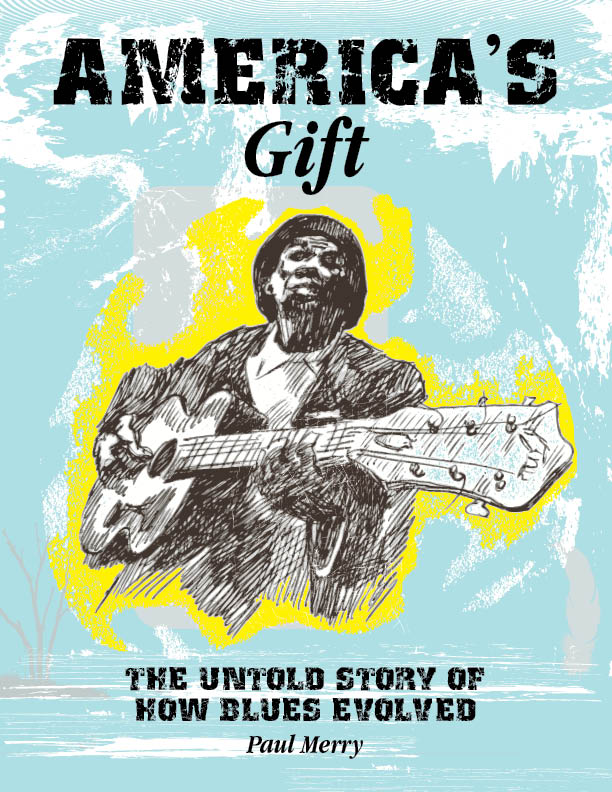
Thanks for your question, Duke. On ‘Everyday Blues (Yo-Yo Blues)’ for Bennie Moten’s Kansas City Orchestra, Eddie Durham played an archetype electric guitar, one he had designed and built himself. You can find this information and more in my book ‘America’s Gift: the untold story of how blues evolved’ available at Amazon Books.