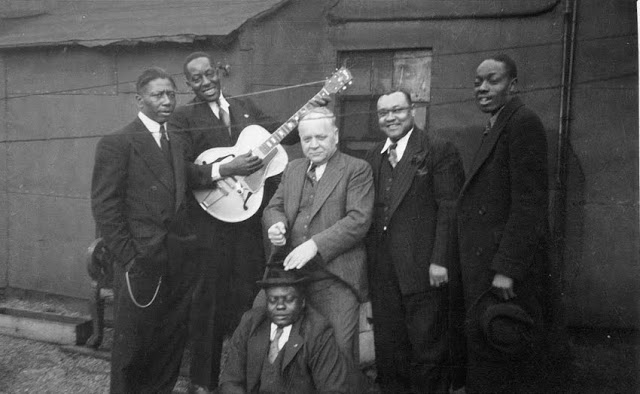

The earliest known bluesman ever?
Updated 3 April 2017.
BluesMuse27
Long ago, when I played rugby, there was an old guy we nicknamed Daddy Stovepipe. Daddy was a human dynamo, still turning out for the seconds or thirds every week and tackling, ferociously, anything that moved in shorts. Daddy did this well into his late 50s before arthritis cut short his career and confined him, I’ve since heard, to a wheelchair. Was his arthritis a result of his rugby playing? Who knows, but one thing was for sure, people said, Daddy Stovepipe would have played for rugby for England if World War Two interrupted his prime playing years. This might just give you a clue as to how long ago it was.
Anyway, I always though Daddy Stovepipe was an odd name; but only when researching my book, How Blues Evolved (and later America’s Gift) did I become aware that Daddy Stovepipe was originally the name of an old African-American blues performer, reaching about as far back in history as old blues performers go.
 |
| Daddy Stovepipe 1867 – 1963 |
We know the original Daddy Stovepipe, born Johnny Watson in 1867 in Mobile, Alabama, played in a mariachi band in Mexico in the late 1890s. Obviously supremely versatile, Watson would certainly be the earliest blues performers ever known, if only we knew the exact genre of music he was playing in America before his Mexican sojourn. Unfortunately we don’t know.
As well as Daddy Stovepipe, Johnnie Watson also recorded under the names of Jimmy Watson, Sunny Jim (my Dad used to call me that) and the Reverend Alfred Pitts. He cut his first record, ‘Sundown Blues’, in Richmond, Indiana, in early 1924 aged 57. It is thought to be the third-ever country blues captured on record.
Johnny ‘Daddy Stovepipe’ Watson’s last record was made in 1960, at the grand old age of 93 and he died three years later aged 96. His nickname was due to the stovepipe hat that he always wore.
The puzzling thing is, somebody in middle England must have known of this old blues player’s existence way back in the 1940s when a young English rugby player called David Stovell acquired the most unusual of nicknames: Daddy Stovepipe. People who know about blues turn up in the most unexpected places, don’t they?
To read the first two chapters of HOW BLUES EVOLVES, VOLUMES ONE AND TWO free please follow these links.
Available in USA on
http://www.amazon.com/s/ref=nb_sb_noss?url=search-alias%3Dstripbooks&field-keywords=how+blues+evolved
Available in UK on
http://www.amazon.co.uk/s/ref=nb_sb_noss?url=search-alias%3Ddigital-text&field-keywords=how+blues+evolved+volume+one
http://www.amazon.com/s/ref=nb_sb_noss?url=search-alias%3Dstripbooks&field-keywords=how+blues+evolved
Available in UK on
http://www.amazon.co.uk/s/ref=nb_sb_noss?url=search-alias%3Ddigital-text&field-keywords=how+blues+evolved+volume+one
Also at Amazon Books, America’s Gift.